
digital marketing consultant in kerala
SEO Isn't Dead — But It's Not Enough Anymore: Why Every Digital Marketer Needs an AEO/GEO Strategy in 2026
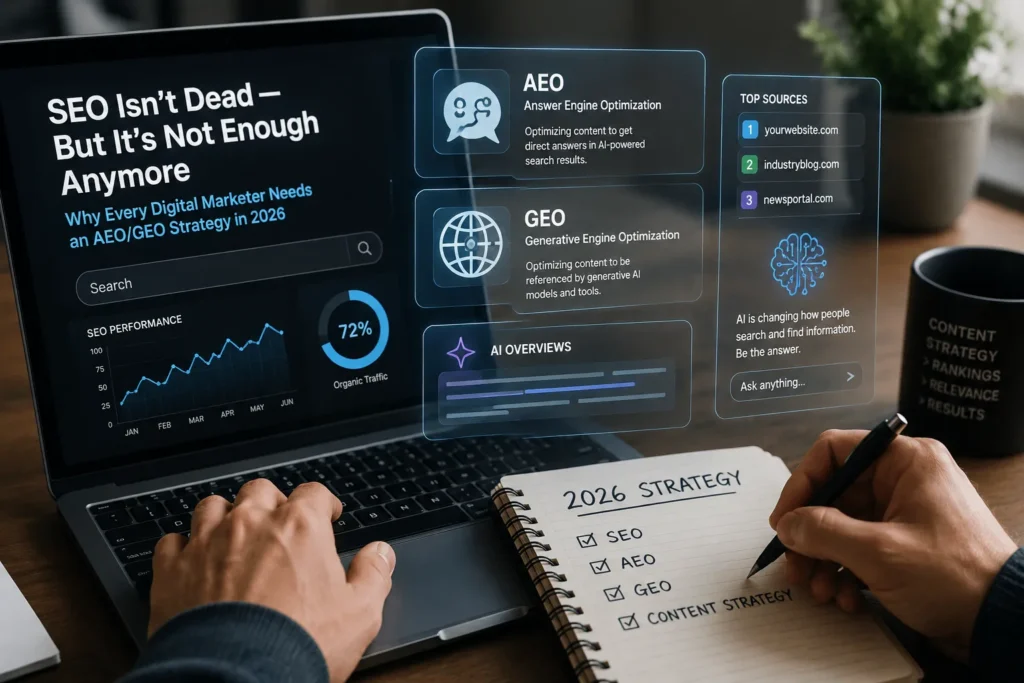
“SEO Is Dead” has been said every couple of years, most recently in 2020, 2024, and now again, in 2026. And while in the past such headlines were purely hype, in 2026, there’s a reality behind that claim.
As a digital marketing consultant in kerala Search itself hasn’t disappeared. The methods of how people search, and what it means to be “ranking well,” have shifted drastically, however. The game of visibility isn’t merely being played on Google result pages anymore; it’s happening in the context of an AI-mediated middle layer between your potential readers and the open web.
If your content strategy revolves solely around traditional SEO, you’re positioning yourself for a game that’s already being played differently.
How Search Behavior Has Actually Changed
As a digital marketing consultant in kerala The change can be described very simply: people are finding brands and information via social media content, creator recommendations, and communities before turning to search engines later to confirm what they have found – not to find it.
Moreover, generative AI has transformed the way people receive their responses. Instead of having to click on ten blue links, more and more searches will be answered within an AI-powered summary, where no clicks are necessary anymore. In other words, if your content was not used by the algorithm to produce that summary, then you are invisible in this technically successful search.
This is the basis of a new concept called AEO (Answer Engine Optimization) or GEO (Generative Engine Optimization).
The New Ranking Currency: EEAT
Where keyword optimization and backlinking used to be the currency of old SEO, EEAT – Experience, Expertise, Authoritativeness, and Trustworthiness – is becoming the currency of modern AI SEO.
As a digital marketing consultant in kerala When large language models create a summary of your page through an AI search, they have to make a decision about whether or not your page can be used as a credible source in the response they create. The decisions depend heavily on the following criteria:
Experience – does this information come from personal experience or firsthand knowledge or is it generic information that could be found anywhere else?
Expertise – is there a credible author or organization who could write or publish information on the topic?
Authoritativeness – is this source credible enough that it is being cited by anyone else?
Trustworthiness – is this source providing reliable information based on credible sources and facts?
The bottom line is that generic and shallow content is the exact type of content that should be filtered out by AI search.
What This Looks Like in Practice
Transitioning from traditional SEO into AEO/GEO does not require discarding anything you’ve learned about search optimization. Rather, it involves adding some extra layers of considerations:
1. Share original data and research. AI-powered systems prefer content that contains unique insights or ideas that cannot be found elsewhere. Unique survey data, internal benchmark data, original case studies – all of these can be used as the source of originality. Not “ultimate guides to X.”
2. Highlight authorship and expertise. Byline, an actual author biography and the presence of “About Us” page – all of those play into making content trustworthy – for both people and models that analyze it.
3. Structure content to make it extractable. Headers, answers at the top of the article, list structures, definitions – all of those increase chances of getting extracted and cited.
4. Include structured data markup. Schema markup (FAQ pages, Article, Organization, etc.) is important here too – probably even more so, as it allows machines to clearly identify nature of the content and its source.
5. Don’t abandon your existing SEO fundamentals. Site speed, mobile experience, solid technical SEO, and quality backlinks haven’t become irrelevant — they’re just no longer the whole story. Think of AEO/GEO as an additional layer, not a replacement.
A New Way to Think About "Ranking
As a digital marketing consultant in kerala The change in mindset that’s important here: don’t wonder “how can I get ranked number one for this keyword?” but rather ask “if there were a summarizer AI looking at this topic, would it have a reason to cite my content?”
That second question requires an entirely new approach – an approach based on being uniquely original and an expert in your field, and providing value that’s so great that both an AI and its user would link back to your content.
The Bottom Line
SEO is not dead; rather, it is being swallowed by something else. It is those SEO professionals who believe that all this is merely “more of the same, only with additional schema markup” who are going to get left behind. As a digital marketing consultant in kerala It is those who understand this for what it is — a paradigm shift in visibility — and begin creating truly original, well-written, and properly structured content who will continue to be found, either by people or machines.